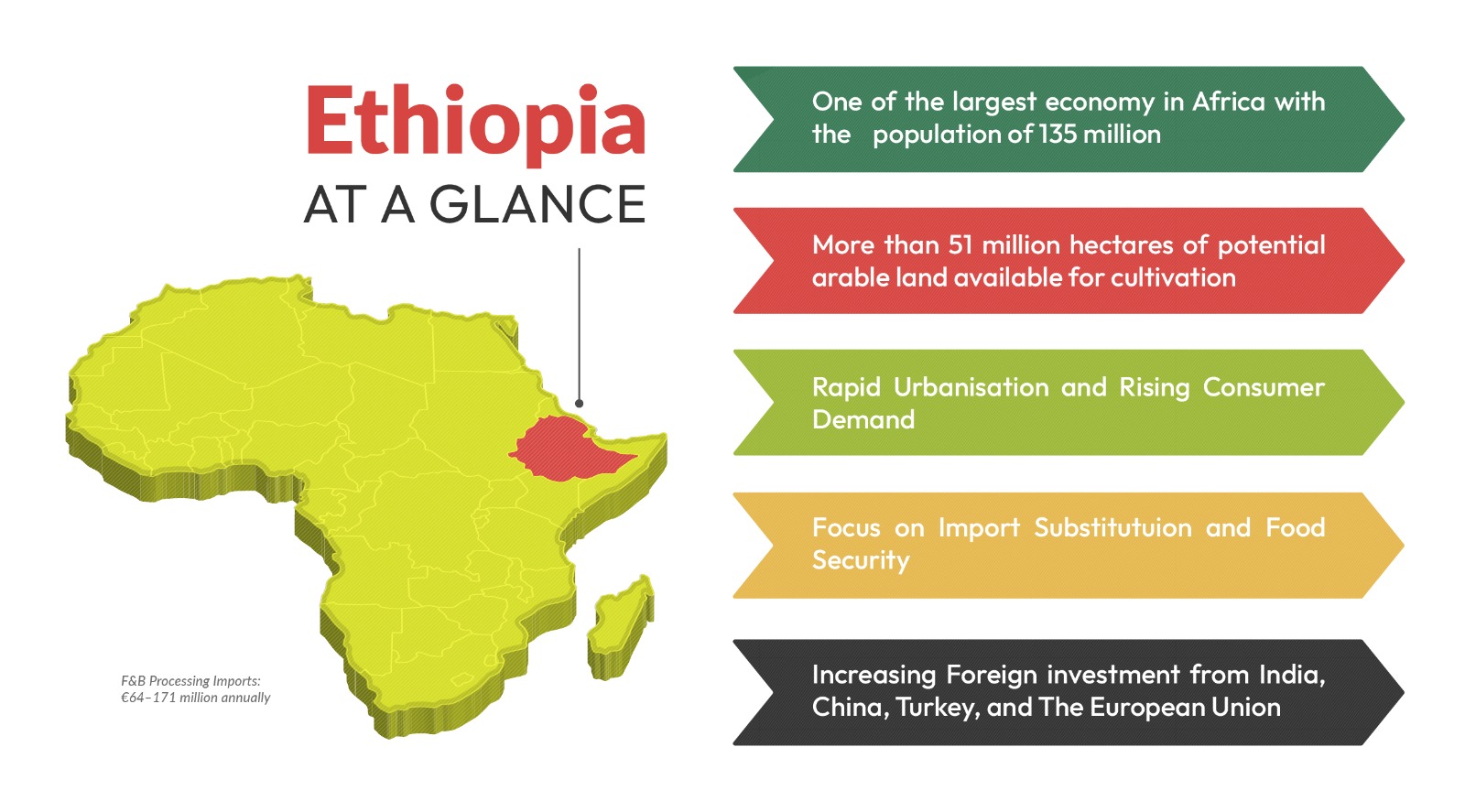
Ethiopia is one of the biggest food markets in African continent, and imports significant amounts of food, primarily including wheat, pulses, and cooking oil. Ethiopia’s total food importation in 2023 touched USD 2.36 Bn and India, USA, Turkey, Djibouti, Malaysia, Indonesia, UAE, Egypt etc. Despite accounting for half the country’s total manufacturing, agro-industries account for only five percent of Ethiopia’s GDP.
While Ethiopia produces a large volume of agricultural commodities, only a small percentage is processed domestically. The government aims to expand food and beverage manufacturing capacity through policies that support agro-industrial zones, export promotion, and investment incentives.
Currently, four Integrated Agro-Industrial Parks (IAIP) are under construction, out of which three are already operational. These IAIPs will provide support services for skills development and will be an attractive destination for foreign investment. The four industrial parks are located in Humera (Tigray), Bure (Amhara), Yirgalem (SNNPR), and Bulbula (Oromia).
Currently, four Integrated Agro-Industrial Parks (IAIP) are under construction, out of which three are already operational. These IAIPs will provide support services to companies and opportunities for skills development and will be an attractive destination for foreign investment. The four industrial parks are located in Humera (Tigray), Bure (Amhara), Yirgalem (SNNP), and Bulbula (Oromia).
Ethiopia has made wheat production a central pillar in its journey toward food self-sufficiency. Through the expansion of irrigated farming, the use of improved seed varieties, and the adoption of modern farming techniques, the country has significantly increased its wheat yield and marketable surplus.




For all queries kindly write to us on projects@synergiceindia.com


 About AGROFOOD EAST AFRICA